> ## Documentation Index
> Fetch the complete documentation index at: https://docs.derive.xyz/llms.txt
> Use this file to discover all available pages before exploring further.
# Managers & Risk Universes
> How margin managers and risk universes shape what a subaccount can trade and hold.
Every subaccount is bound to a **manager** and, through it, to a **risk universe**. Together they
decide the margin model you get, which instruments you can trade, and which assets you can post as
collateral. You never set the universe directly — you pick a `manager_id`, and everything else
follows.
The margin model applied to your subaccount — **Standard** (cross collateral margin) or
**Portfolio** (scenario-based netting).
Restricted set of instruments, collaterals and lending rules, aimed at containing risk. Losses are socialized only **within** it.
## How they relate
* A subaccount can only have **one** manager.
* A manager belongs to **exactly one** universe.
* A universe exposes **at most one Standard and one Portfolio** manager.
* You choose a `manager_id`; that fixes both your **margin model** and your **universe**.
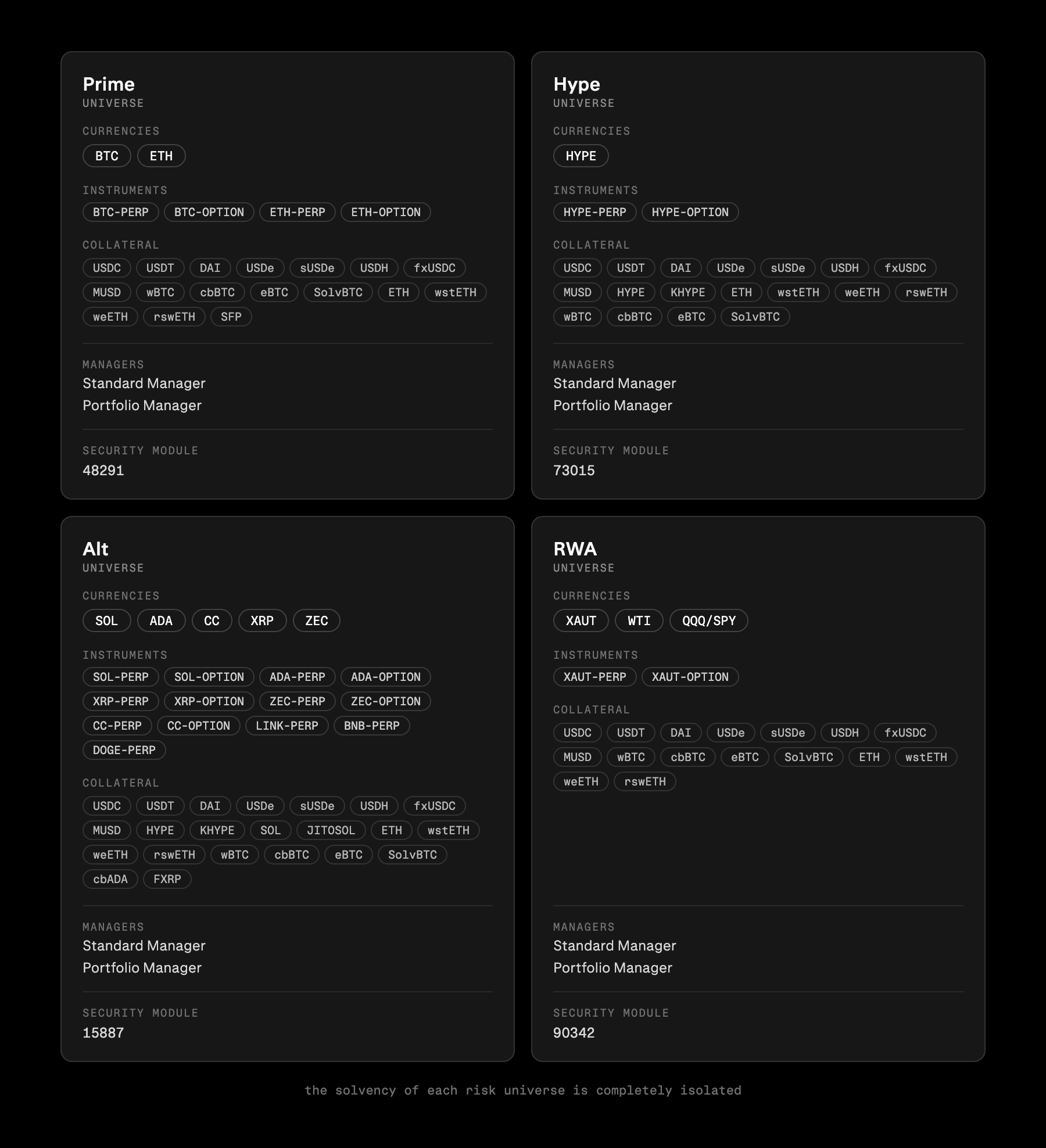 This breakdown is exactly what `public/get_risk_universes` returns — see
[Reading `public/get_risk_universes`](#reading-public-get-risk-universes) below.
## Managers
A manager is the margin engine that risk-prices your subaccount. There are two:
| Manager | Wire label | Margin model | Best for |
| ------------- | ---------- | -------------------------------------------------------------------------------- | ------------------------------------------------------------------- |
| **Standard** | `SM` | Cross-collateral: collaterals contribute margin but options margined separately. | Simple/directional positions and collateral-style holding. |
| **Portfolio** | `PM2` | Scenario-based: a whole book netted across a grid of shocks. | Complex option/perp books that benefit from cross-position offsets. |
Each manager has a numeric **`manager_id`**. A subaccount stores its `manager_id` and derives its
universe, tradeable instruments, and accepted collateral from it. Picking Standard vs Portfolio for
the same book changes your margin requirement, not what you can hold.
## Risk universes
A risk universe is a set of assets and managers that share a single risk boundary. It exists so
that an insolvency in one universe can only ever be absorbed by that universe's own Security Module
and, if needed, socialized to solvent accounts **inside the same universe** — never across the
whole exchange. As a direct consequence, **a trade, RFQ, or liquidation is rejected if the two
sides sit in different universes.**
Everything risk-related is keyed by `(asset, risk_universe_id)`: collateral discounts, OI caps, and
lending pools can all differ per universe for the very same asset.
## Two ways to find a manager
* **By risk universe — `public/get_risk_universes`**. Break down all trade-able instruments and supported collaterals by universe and manager.
* **By currency — `public/get_all_currencies`**. Similar to above but broken down by currency. This route also includes market summary data such as APYs, borrow headroom, OI details and caps.
## Reading `public/get_risk_universes`
```json Response (abridged, one universe) theme={null}
{
"risk_universe_id": 1,
"name": "PRIME",
"description": "Blue chip universe",
"managers": [
{
"manager_id": 3,
"margin_type": "SM",
"instruments": ["BTC-OPTION", "BTC-PERP", "ETH-OPTION", "ETH-PERP"],
"collaterals": [
{
"name": "USDC",
"address": "0x…",
"erc20": { "decimals": 6, "underlying_erc20": "0x…" },
"min_deposit_usd": "1",
"im_discount": "1",
"mm_discount": "1"
},
{
"name": "ETH",
"address": "0x…",
"erc20": { "decimals": 18, "underlying_erc20": "0x…" },
"min_deposit_usd": "1",
"im_discount": "0.72",
"mm_discount": "0.8"
}
]
},
{ "manager_id": 12, "margin_type": "PM2", "instruments": ["…"], "collaterals": ["…"] }
],
"security_module": { "subaccount_id": 48291, "cash_asset": "0x…", "cash_currency": "USDC" }
}
```
| To determine… | Read… |
| ---------------------------------------------- | ------------------------------------------------------------------------------------------------------- |
| Which universes exist, and what they're called | one entry per universe; `name`/`description` are display metadata (absent until set) |
| Which `manager_id` to use | pick a manager by `margin_type` (`SM` = Standard, `PM2` = Portfolio); its `manager_id` is what you pass |
| What you can trade under a manager | `managers[].instruments[]` — the live perp/option asset names (an option entry names the family) |
| What you can deposit as **collateral** | `managers[].collaterals[]` — `address` is the deposit `asset`, `erc20` the token to send + decimals |
| How much margin a collateral earns | `collaterals[].im_discount` / `mm_discount` under that manager (`"1"` = par credit — the cash asset) |
| Who absorbs losses | `security_module` — the universe's SM subaccount and its cash asset |
For app builders, `public/get_all_currencies` carries useful market data that can be useful for onboarding such as open interest caps, lending limits, APYs.
### Picking your manager
Settle on the instruments you want to trade (e.g. `ETH-OPTION`) and the collateral you'll post
(e.g. `USDC`). If you care about the margin model, decide `SM` (Standard cross-collateral) or
`PM2` (Portfolio) too.
Call `public/get_risk_universes` and scan its managers for the one whose `instruments[]` include
what you want to trade and whose `collaterals[]` include what you'll post (add a `margin_type`
filter if you want a specific model). Its `manager_id` is the id you pass everywhere.
Check your collateral's `im_discount` under that manager is non-zero — `"0"` means the manager
holds it but grants no margin against it.
Pass the chosen id as `manager_id` when depositing to a new subaccount (see [Depositing](/getting-started/depositing)) —
the collateral entry's `address` is the deposit `asset`. Universe, instruments, and collateral
set all follow from it. You can read them back on `private/get_subaccount` via its `manager_id`
and `risk_universe_id`.
```typescript TypeScript (SDK) theme={null}
import { DeriveClient } from '@derivexyz/derive-ts';
// Public read — no login required.
const client = new DeriveClient({ network: 'mainnet', wallet: process.env.PRIVATE_KEY! });
// Universe-first: pick the manager that trades ETH options and accepts USDC.
const universes = await client.marketData.getRiskUniverses();
const manager = universes
.flatMap((u) => u.managers)
.find((m) => m.instruments.includes('ETH-OPTION') && m.collaterals.some((c) => c.name === 'USDC'))!;
const usdc = manager.collaterals.find((c) => c.name === 'USDC')!;
console.log(manager.manager_id, manager.margin_type, usdc.address);
```
```python Python (SDK) theme={null}
import asyncio
from derive_py import WebSocketClient
async def main():
client = WebSocketClient.from_env()
await client.connect()
# Universe-first: pick the manager that trades ETH options and accepts USDC.
universes = await client.markets.get_risk_universes()
manager = next(
m
for u in universes
for m in u.managers
if "ETH-OPTION" in m.instruments and any(c.name == "USDC" for c in m.collaterals)
)
usdc = next(c for c in manager.collaterals if c.name == "USDC")
print(manager.manager_id, manager.margin_type, usdc.address)
await client.disconnect()
asyncio.run(main())
```
```rust Rust (SDK) theme={null}
use derive_rs::{Environment, WsClient};
#[tokio::main]
async fn main() -> Result<(), Box> {
// Public read — no login required.
let client = WsClient::new_public(Environment::Mainnet).await?;
let universes = client.rpc().market_data().get_risk_universes().await?;
// Universe-first: pick the manager that trades ETH options and accepts USDC.
let manager = universes
.iter()
.flat_map(|u| &u.managers)
.find(|m| {
m.instruments.contains(&"ETH-OPTION".to_string())
&& m.collaterals.iter().any(|c| c.name == "USDC")
})
.expect("no manager trades ETH options against USDC");
let usdc = manager
.collaterals
.iter()
.find(|c| c.name == "USDC")
.expect("USDC collateral missing");
println!("{} {:?} {}", manager.manager_id, manager.margin_type, usdc.address);
Ok(())
}
```
Choosing the wrong id has consequences at deposit and trade time:
* **Fallback routing** — depositing to a non-existant manager or one that doesn't support your asset sends the funds to the fallback subaccount (universe `0`).
* **Cross-universe trade** — a subaccount can't trade against a counterparty in a different universe; the order is
rejected.
## The fallback universe
Universe **`0`** is a special **fallback** ("lost-and-found") universe: a no-margin holding area whose
only job is to safely custody collateral that has nowhere else to go. It registers every spot asset
but supports **no trading, borrowing, options, or perps**.
Every wallet is given a single fallback subaccount when its account is created. A deposit lands there —
instead of the subaccount you intended — whenever it can't be honoured as requested:
* it targets the fallback manager (`manager_id` `0`),
* the asset isn't registered in the target manager's universe, or
* the amount is below the subaccount-creation fee.
Funds in the fallback subaccount are safe but idle — you can't trade against them. To put them to work,
move the spot out to a real subaccount with `private/transfer_spot`.
The fallback appears in `public/get_risk_universes` like any other universe (as id `0`, listed
first) — with no tradeable instruments. Skip it when choosing where to deposit.
## Related topics
- [Error Codes](/error-codes.md)
- [New features](/migrating/new-features.md)
- [Programmatic Onboarding](/getting-started/depositing.md)
This breakdown is exactly what `public/get_risk_universes` returns — see
[Reading `public/get_risk_universes`](#reading-public-get-risk-universes) below.
## Managers
A manager is the margin engine that risk-prices your subaccount. There are two:
| Manager | Wire label | Margin model | Best for |
| ------------- | ---------- | -------------------------------------------------------------------------------- | ------------------------------------------------------------------- |
| **Standard** | `SM` | Cross-collateral: collaterals contribute margin but options margined separately. | Simple/directional positions and collateral-style holding. |
| **Portfolio** | `PM2` | Scenario-based: a whole book netted across a grid of shocks. | Complex option/perp books that benefit from cross-position offsets. |
Each manager has a numeric **`manager_id`**. A subaccount stores its `manager_id` and derives its
universe, tradeable instruments, and accepted collateral from it. Picking Standard vs Portfolio for
the same book changes your margin requirement, not what you can hold.
## Risk universes
A risk universe is a set of assets and managers that share a single risk boundary. It exists so
that an insolvency in one universe can only ever be absorbed by that universe's own Security Module
and, if needed, socialized to solvent accounts **inside the same universe** — never across the
whole exchange. As a direct consequence, **a trade, RFQ, or liquidation is rejected if the two
sides sit in different universes.**
Everything risk-related is keyed by `(asset, risk_universe_id)`: collateral discounts, OI caps, and
lending pools can all differ per universe for the very same asset.
## Two ways to find a manager
* **By risk universe — `public/get_risk_universes`**. Break down all trade-able instruments and supported collaterals by universe and manager.
* **By currency — `public/get_all_currencies`**. Similar to above but broken down by currency. This route also includes market summary data such as APYs, borrow headroom, OI details and caps.
## Reading `public/get_risk_universes`
```json Response (abridged, one universe) theme={null}
{
"risk_universe_id": 1,
"name": "PRIME",
"description": "Blue chip universe",
"managers": [
{
"manager_id": 3,
"margin_type": "SM",
"instruments": ["BTC-OPTION", "BTC-PERP", "ETH-OPTION", "ETH-PERP"],
"collaterals": [
{
"name": "USDC",
"address": "0x…",
"erc20": { "decimals": 6, "underlying_erc20": "0x…" },
"min_deposit_usd": "1",
"im_discount": "1",
"mm_discount": "1"
},
{
"name": "ETH",
"address": "0x…",
"erc20": { "decimals": 18, "underlying_erc20": "0x…" },
"min_deposit_usd": "1",
"im_discount": "0.72",
"mm_discount": "0.8"
}
]
},
{ "manager_id": 12, "margin_type": "PM2", "instruments": ["…"], "collaterals": ["…"] }
],
"security_module": { "subaccount_id": 48291, "cash_asset": "0x…", "cash_currency": "USDC" }
}
```
| To determine… | Read… |
| ---------------------------------------------- | ------------------------------------------------------------------------------------------------------- |
| Which universes exist, and what they're called | one entry per universe; `name`/`description` are display metadata (absent until set) |
| Which `manager_id` to use | pick a manager by `margin_type` (`SM` = Standard, `PM2` = Portfolio); its `manager_id` is what you pass |
| What you can trade under a manager | `managers[].instruments[]` — the live perp/option asset names (an option entry names the family) |
| What you can deposit as **collateral** | `managers[].collaterals[]` — `address` is the deposit `asset`, `erc20` the token to send + decimals |
| How much margin a collateral earns | `collaterals[].im_discount` / `mm_discount` under that manager (`"1"` = par credit — the cash asset) |
| Who absorbs losses | `security_module` — the universe's SM subaccount and its cash asset |
For app builders, `public/get_all_currencies` carries useful market data that can be useful for onboarding such as open interest caps, lending limits, APYs.
### Picking your manager
Settle on the instruments you want to trade (e.g. `ETH-OPTION`) and the collateral you'll post
(e.g. `USDC`). If you care about the margin model, decide `SM` (Standard cross-collateral) or
`PM2` (Portfolio) too.
Call `public/get_risk_universes` and scan its managers for the one whose `instruments[]` include
what you want to trade and whose `collaterals[]` include what you'll post (add a `margin_type`
filter if you want a specific model). Its `manager_id` is the id you pass everywhere.
Check your collateral's `im_discount` under that manager is non-zero — `"0"` means the manager
holds it but grants no margin against it.
Pass the chosen id as `manager_id` when depositing to a new subaccount (see [Depositing](/getting-started/depositing)) —
the collateral entry's `address` is the deposit `asset`. Universe, instruments, and collateral
set all follow from it. You can read them back on `private/get_subaccount` via its `manager_id`
and `risk_universe_id`.
```typescript TypeScript (SDK) theme={null}
import { DeriveClient } from '@derivexyz/derive-ts';
// Public read — no login required.
const client = new DeriveClient({ network: 'mainnet', wallet: process.env.PRIVATE_KEY! });
// Universe-first: pick the manager that trades ETH options and accepts USDC.
const universes = await client.marketData.getRiskUniverses();
const manager = universes
.flatMap((u) => u.managers)
.find((m) => m.instruments.includes('ETH-OPTION') && m.collaterals.some((c) => c.name === 'USDC'))!;
const usdc = manager.collaterals.find((c) => c.name === 'USDC')!;
console.log(manager.manager_id, manager.margin_type, usdc.address);
```
```python Python (SDK) theme={null}
import asyncio
from derive_py import WebSocketClient
async def main():
client = WebSocketClient.from_env()
await client.connect()
# Universe-first: pick the manager that trades ETH options and accepts USDC.
universes = await client.markets.get_risk_universes()
manager = next(
m
for u in universes
for m in u.managers
if "ETH-OPTION" in m.instruments and any(c.name == "USDC" for c in m.collaterals)
)
usdc = next(c for c in manager.collaterals if c.name == "USDC")
print(manager.manager_id, manager.margin_type, usdc.address)
await client.disconnect()
asyncio.run(main())
```
```rust Rust (SDK) theme={null}
use derive_rs::{Environment, WsClient};
#[tokio::main]
async fn main() -> Result<(), Box> {
// Public read — no login required.
let client = WsClient::new_public(Environment::Mainnet).await?;
let universes = client.rpc().market_data().get_risk_universes().await?;
// Universe-first: pick the manager that trades ETH options and accepts USDC.
let manager = universes
.iter()
.flat_map(|u| &u.managers)
.find(|m| {
m.instruments.contains(&"ETH-OPTION".to_string())
&& m.collaterals.iter().any(|c| c.name == "USDC")
})
.expect("no manager trades ETH options against USDC");
let usdc = manager
.collaterals
.iter()
.find(|c| c.name == "USDC")
.expect("USDC collateral missing");
println!("{} {:?} {}", manager.manager_id, manager.margin_type, usdc.address);
Ok(())
}
```
Choosing the wrong id has consequences at deposit and trade time:
* **Fallback routing** — depositing to a non-existant manager or one that doesn't support your asset sends the funds to the fallback subaccount (universe `0`).
* **Cross-universe trade** — a subaccount can't trade against a counterparty in a different universe; the order is
rejected.
## The fallback universe
Universe **`0`** is a special **fallback** ("lost-and-found") universe: a no-margin holding area whose
only job is to safely custody collateral that has nowhere else to go. It registers every spot asset
but supports **no trading, borrowing, options, or perps**.
Every wallet is given a single fallback subaccount when its account is created. A deposit lands there —
instead of the subaccount you intended — whenever it can't be honoured as requested:
* it targets the fallback manager (`manager_id` `0`),
* the asset isn't registered in the target manager's universe, or
* the amount is below the subaccount-creation fee.
Funds in the fallback subaccount are safe but idle — you can't trade against them. To put them to work,
move the spot out to a real subaccount with `private/transfer_spot`.
The fallback appears in `public/get_risk_universes` like any other universe (as id `0`, listed
first) — with no tradeable instruments. Skip it when choosing where to deposit.
## Related topics
- [Error Codes](/error-codes.md)
- [New features](/migrating/new-features.md)
- [Programmatic Onboarding](/getting-started/depositing.md)