> ## Documentation Index
> Fetch the complete documentation index at: https://docs.derive.xyz/llms.txt
> Use this file to discover all available pages before exploring further.
# Programmatic Onboarding
> Integrate your app within minutes.
User onboarding on Derive is **fully programmatic** - no humans in the loop.
You can integrate the Derive Exchange for your users within minutes.
Your account and first subaccount come into existence the moment a deposit is
credited to your wallet on-chain.
## The account model
Three terms show up throughout the API. They nest:
* **Wallet** — your Ethereum EOA (the address that owns everything). One wallet ↔ one account.
* **Subaccount** — the unit you actually trade from. It holds collateral and positions and is identified by a numeric `subaccount_id`. A wallet can own many.
* **Manager** — the margin/risk model a subaccount runs under: **standard (cross) margin** or **portfolio margin**. You pick a manager when the subaccount is created; it also fixes the subaccount's risk universe.
A brand-new wallet's first deposit creates **two** subaccounts: the funded one you asked for, plus a **fallback
subaccount** (under manager id `0`) that catches any deposit that can't be applied to its intended target. Expect two
ids to appear the first time — the fallback is normal.
v3 has no `private/create_subaccount` method — subaccounts are created **on-chain by depositing**. See the
[changelog](/changelog) for the v2 → v3 method changes.
## Step 1 — Choose deposit params
When depositing to a new subaccount you must chose a **risk universe / manager**.
Use `public/get_risk_universes` to list every
universe with its managers and their accepted collaterals / instruments.
See [Managers & risk universes](/trading/managers-and-risk-universes) for how to choose.
```typescript TypeScript (SDK) theme={null}
import { DeriveClient } from '@derivexyz/derive-ts';
// Public read — no login required.
const client = new DeriveClient({
network: 'mainnet',
wallet: process.env.PRIVATE_KEY!,
});
const universes = await client.marketData.getRiskUniverses();
// Pick the manager that trades what you want (ETH options)
// and accepts the collateral you'll post (USDC).
const manager = universes
.flatMap((u) => u.managers)
.find((m) => m.instruments.includes('ETH-OPTION') && m.collaterals.some((c) => c.name === 'USDC'))!;
const usdc = manager.collaterals.find((c) => c.name === 'USDC')!;
console.log(manager.manager_id, usdc.address, usdc.erc20);
```
```python Python (SDK) theme={null}
import asyncio
from derive_py import WebSocketClient
async def main():
client = WebSocketClient.from_env()
await client.connect()
universes = await client.markets.get_risk_universes()
# Pick the manager that trades what you want (ETH options)
# and accepts the collateral you'll post (USDC).
manager = next(
m
for u in universes
for m in u.managers
if "ETH-OPTION" in m.instruments and any(c.name == "USDC" for c in m.collaterals)
)
usdc = next(c for c in manager.collaterals if c.name == "USDC")
print(manager.manager_id, usdc.address, usdc.erc20)
await client.disconnect()
asyncio.run(main())
```
```rust Rust (SDK) theme={null}
use derive_rs::{Environment, WsClient};
#[tokio::main]
async fn main() -> Result<(), Box> {
// Public read — no login required.
let client = WsClient::new_public(Environment::Mainnet).await?;
let universes = client.rpc().market_data().get_risk_universes().await?;
// Pick the manager that trades what you want (ETH options)
// and accepts the collateral you'll post (USDC).
let manager = universes
.iter()
.flat_map(|u| &u.managers)
.find(|m| {
m.instruments.contains(&"ETH-OPTION".to_string())
&& m.collaterals.iter().any(|c| c.name == "USDC")
})
.expect("no manager trades ETH options against USDC");
let usdc = manager
.collaterals
.iter()
.find(|c| c.name == "USDC")
.expect("USDC collateral missing");
println!("{} {} {:?}", manager.manager_id, usdc.address, usdc.erc20);
Ok(())
}
```
### What each asset field means
| Value | Where it comes from | Used as |
| ------------------------------ | ------------------------------- | ------------------------------------------------------------------------------- |
| Protocol spot asset address | `collaterals[].address` | the `asset` in the on-chain deposit call |
| Underlying ERC-20 + `decimals` | `collaterals[].erc20` | the token you approve/send, and how to scale the amount |
| Minimum deposit | `collaterals[].min_deposit_usd` | deposits below this amount will be donated to the security module |
| Margin credit | `collaterals[].im_discount` | how much margin the asset earns under this manager (`"0"` = held but no credit) |
## Step 2 — Deposit
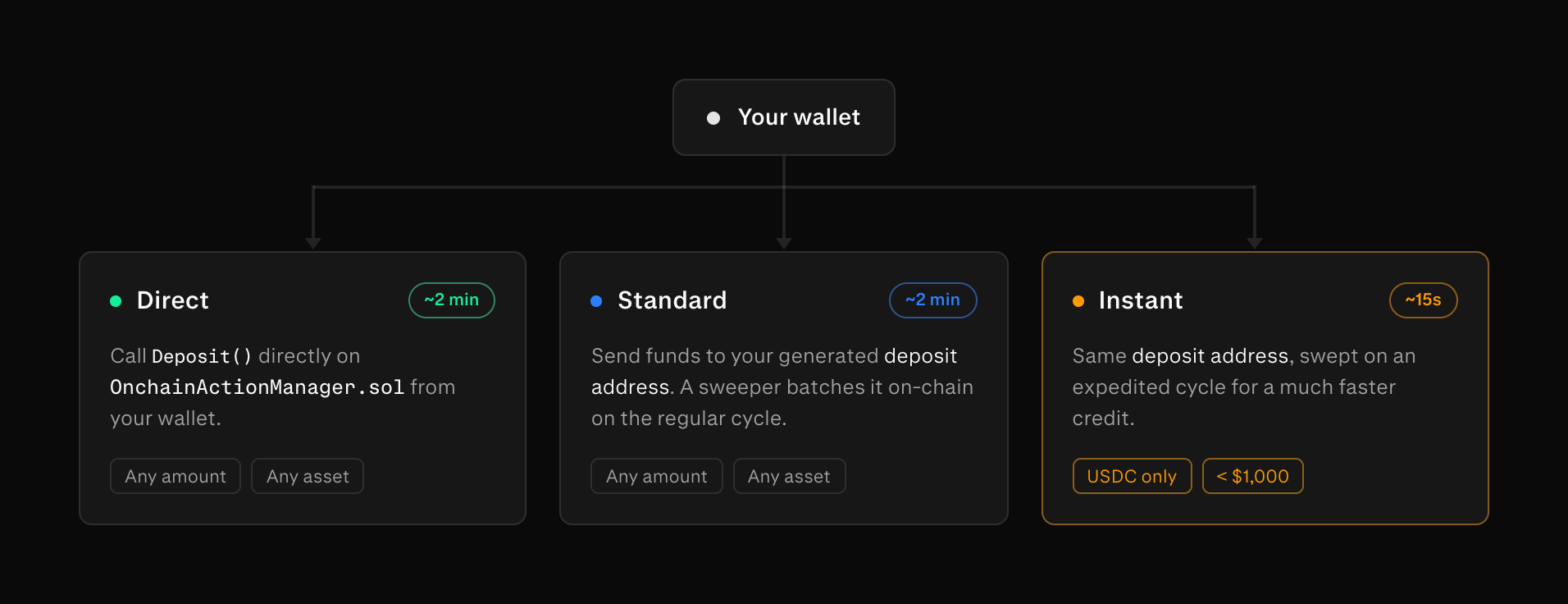
You can deposit 3 different ways - each ideal for different types of users:
1. Direct: call the `Deposit()` or `DepositNewSubaccount()` calls on the `OnchainActionManager.sol`. (\~2 min)
2. Standard: less integration work as simply requires user to send funds to a custom ETH address from where a keeper will auto deposit funds into the exchange. (\~2 min)
3. Instant: fastest deposit times at \~15 seconds, with same integration simplicity to `standard`. Currently only supported for USDC (reach out if you'd like other collaterals) and for amounts \<\$1k. There also may be a small
fee depending on network conditions.
 Your own wallet calls the settlement contract (`ACTION_MANAGER`, address per [Contracts](/getting-started/contracts)). First
`approve` the contract to pull your ERC-20, then call one of:
* **`depositToNewSubaccount(asset, amount, managerId, owner)`** — create a new subaccount under `managerId`, owned by `owner`.
* **`deposit(asset, amount, subaccountId, fallbackRecipient)`** — fund an existing `subaccountId`; `fallbackRecipient` receives the funds into its fallback subaccount if the deposit cannot be applied.
`asset` is the **protocol spot asset address** (`collaterals[].address` from Step 1), **not** the ERC-20 token. `amount` is in the token's **native ERC-20 decimals**
```typescript TypeScript (SDK) theme={null}
import { DeriveClient } from '@derivexyz/derive-ts';
import { ethers } from 'ethers';
// The SDK holds no provider — supply an ethers signer connected to the
// settlement-chain RPC; it signs the approve + deposit for you.
const provider = new ethers.JsonRpcProvider(SETTLEMENT_CHAIN_RPC_URL);
const signer = new ethers.Wallet(OWNER_PRIVATE_KEY, provider);
// No login needed — a Direct deposit is a pure on-chain call; the network
// config supplies the ActionManager and USDC addresses.
const client = new DeriveClient({ network: 'mainnet' });
// ASSET_ADDRESS = collaterals[].address (protocol asset, NOT the ERC-20) and
// MANAGER_ID = manager_id, both from Step 1. Approves the ActionManager to
// pull the ERC-20 (defaults to the network's USDC), then deposits into a NEW
// subaccount under MANAGER_ID, owned by the signer.
const { txHash } = await client.deposits.contractCall.depositToNewSubaccount({
signer,
asset: ASSET_ADDRESS,
amount: '100', // human units — scaled by the ERC-20's on-chain decimals()
managerId: MANAGER_ID,
});
// Mined on-chain; crediting still happens asynchronously (Step 3).
```
```python Python (SDK) theme={null}
import asyncio
from derive_py import WebSocketClient
from derive_py.data_types import D, MarginType, RiskUniverseID
async def main():
client = WebSocketClient.from_env()
await client.connect()
# No login needed for the on-chain part — the client holds the wallet key
# and the network config supplies the ActionManager and USDC addresses.
# amount is in HUMAN units; the SDK scales by the ERC-20's decimals().
steps = client.plan_deposit_to_new_subaccount(
risk_universe_id=RiskUniverseID.PRIME,
margin_type=MarginType.SM,
asset_name="USDC",
amount=D("100"),
)
# One step per tx: the ERC-20 approve (skipped if already approved),
# then the deposit into a NEW subaccount owned by the signer.
async for step in steps:
print(f"[{step.kind}] {step.description}")
tx_hash = await step.submit()
receipt = await step.wait_for_finality()
print(f" {tx_hash} in block {receipt.blockNumber}")
# Mined on-chain; crediting still happens asynchronously (Step 3).
await client.disconnect()
asyncio.run(main())
```
```rust Rust (SDK) theme={null}
use std::str::FromStr;
use alloy::primitives::Address;
use bigdecimal::BigDecimal;
use derive_rs::{
Environment, WsClient,
actions::{DepositArgs, DepositTypes, DirectDepositType, SupportDepositAssets},
};
#[tokio::main]
async fn main() -> Result<(), Box> {
let wallet: Address = std::env::var("DERIVE_WALLET")?.parse()?;
let client = WsClient::new(
Environment::Mainnet,
Some(std::env::var("DERIVE_PRIVATE_KEY")?),
Some(wallet.to_string()),
None, // no subaccount yet — this deposit creates one
)
.await?;
// MANAGER_ID comes from Step 1. amount is in HUMAN units; the SDK scales it
// by the ERC-20's decimals() and approves the ActionManager first if needed.
let args = DepositArgs::builder()
.asset(SupportDepositAssets::USDC)
.amount(BigDecimal::from_str("100")?)
.recepient_address(wallet) // owner of the new subaccount
.manager_id(2)
.deposit_type(DepositTypes::Direct(
DirectDepositType::DepositToNewSubaccount,
))
.build();
// One hash per tx sent: the ERC-20 approve (if required), then the deposit.
for hash in client.fund_movements().deposit(args).await? {
println!("{hash:?}");
}
// Mined on-chain; crediting still happens asynchronously (Step 3).
Ok(())
}
```
```solidity Solidity theme={null}
// Raw calls to OnchainActionManager.sol — from your own contract, a Foundry
// script, or `cast send`.
// ASSET_ADDRESS = collaterals[].address — protocol asset, NOT the ERC-20
// ERC20_ADDRESS = collaterals[].erc20.underlying_erc20
// MANAGER_ID = manager_id of the SM-margin manager
// ACTION_MANAGER = settlement contract — see /getting-started/contracts
interface IERC20 {
function approve(address spender, uint256 amount) external returns (bool);
}
interface IOnchainActionManager {
function depositToNewSubaccount(
address asset,
uint256 amount,
uint32 managerId,
address owner
) external returns (uint256 actionId);
}
function depositToDerive() external {
uint256 amount = 100e6; // native ERC-20 units (USDC = 6 decimals)
// 1. Approve the ActionManager to pull the underlying ERC-20.
IERC20(ERC20_ADDRESS).approve(ACTION_MANAGER, amount);
// 2. Create a new subaccount under MANAGER_ID, owned by this wallet;
// crediting still happens asynchronously (Step 3).
IOnchainActionManager(ACTION_MANAGER).depositToNewSubaccount(
ASSET_ADDRESS,
amount,
MANAGER_ID,
msg.sender
);
}
```
Mainnet settlement-contract addresses are deployment-specific — do not hardcode them from the docs. Confirm the
`ACTION_MANAGER` address for your target deployment on [Contracts](/getting-started/contracts) before mainnet use.
`public/register_deposit_address` returns a **deterministic deposit address** for
`(wallet, subaccount, manager, deposit_type)`. Send the token there from anywhere; an off-chain sweeper forwards it
into the protocol and credits your subaccount. It is a plain public call — **no signature** — and idempotent: calling
it again returns the same address.
Wallet to credit. EIP-55 checksummed.
Existing subaccount to route the deposit into. Omit (or `0`) to create a new subaccount instead.
Manager the new subaccount is created under. **Required and non-zero** when `subaccount_id` is omitted or `0`; ignored
when routing into an existing subaccount.
`"standard"` for Standard, `"instant"` for the **Instant** tab. Each type gets its **own distinct address**
for the same `(wallet, subaccount, manager)`.
```typescript TypeScript (SDK) theme={null}
import { DeriveClient } from '@derivexyz/derive-ts';
// Public call — no login required. The address is deterministic per
// (wallet, subaccount, manager, depositType).
const client = new DeriveClient({
network: 'mainnet',
wallet: process.env.PRIVATE_KEY!,
});
const registration = await client.deposits.depositAddress.register({
wallet: '0xYourWallet',
managerId: 2,
depositType: 'standard',
});
console.log(registration.deposit_address);
```
```python Python (SDK) theme={null}
import asyncio
from derive_py import WebSocketClient
from derive_py.data_types.generated_models import DepositType, RegisterDepositAddressParams
async def main():
# Public call — no login required. The address is deterministic per
# (wallet, subaccount, manager, deposit_type).
client = WebSocketClient.from_env()
await client.connect()
registration = await client.public_api.rpc.register_deposit_address(
RegisterDepositAddressParams(
wallet="0xYourWallet",
manager_id=2,
deposit_type=DepositType.standard,
)
)
print(registration.deposit_address)
await client.disconnect()
asyncio.run(main())
```
```rust Rust (SDK) theme={null}
use derive_rs::{Environment, WsClient, models::RegisterDepositAddressParams};
#[tokio::main]
async fn main() -> Result<(), Box> {
// Public call — no login required. The address is deterministic per
// (wallet, subaccount, manager, depositType).
let client = WsClient::new_public(Environment::Mainnet).await?;
let params = RegisterDepositAddressParams::builder()
.wallet("0xYourWallet")
.manager_id(2)
.deposit_type("standard")
.try_into()?;
let registration = client
.rpc()
.onchain_actions()
.register_deposit_address(params)
.await?;
println!("{}", registration.deposit_address);
Ok(())
}
```
```bash cURL theme={null}
curl -X POST https://api.derive.xyz/v3/public/register_deposit_address \
-H "Content-Type: application/json" \
-d '{
"wallet": "0xYourWallet",
"manager_id": 2,
"deposit_type": "standard"
}'
```
Only send the **registered token** to a deposit address, on the **correct chain** (see [Contracts](/getting-started/contracts)).
The address is bound to the `(wallet, subaccount, manager, deposit_type)` you registered — routing is fixed at
registration time.
The same mechanism as Standard — register with `public/register_deposit_address`, this time with
`deposit_type: "instant"`, and send the token to the returned address — but instead of waiting for L1 finality, the
keeper **fronts** the credit into the exchange within **1-3 minutes**. This is the fastest path to a funded
subaccount.
Instant deposits are currently **USDC only**, for amounts **under \$1,000**, and carry a small fee. An amount above
the instant cap is still credited through this path, in cap-sized chunks: the first chunk lands near-instantly and
the remainder follows chunk by chunk, each with more confirmation depth.
The Instant address is **different** from the Standard address for the same `(wallet, subaccount, manager)` — the
deposit type salts the escrow. Register with the type you intend to use.
```typescript TypeScript (SDK) theme={null}
import { DeriveClient } from '@derivexyz/derive-ts';
const client = new DeriveClient({
network: 'mainnet',
wallet: process.env.PRIVATE_KEY!,
});
const registration = await client.deposits.depositAddress.register({
wallet: '0xYourWallet',
managerId: 2,
depositType: 'instant',
});
console.log(registration.deposit_address);
```
```python Python (SDK) theme={null}
import asyncio
from derive_py import WebSocketClient
from derive_py.data_types.generated_models import DepositType, RegisterDepositAddressParams
async def main():
# Public call — no login required. The address is deterministic per
# (wallet, subaccount, manager, deposit_type).
client = WebSocketClient.from_env()
await client.connect()
registration = await client.public_api.rpc.register_deposit_address(
RegisterDepositAddressParams(
wallet="0xYourWallet",
manager_id=2,
deposit_type=DepositType.instant,
)
)
print(registration.deposit_address)
await client.disconnect()
asyncio.run(main())
```
```rust Rust (SDK) theme={null}
use derive_rs::{Environment, WsClient, models::RegisterDepositAddressParams};
#[tokio::main]
async fn main() -> Result<(), Box> {
let client = WsClient::new_public(Environment::Mainnet).await?;
let params = RegisterDepositAddressParams::builder()
.wallet("0xYourWallet")
.manager_id(2)
.deposit_type("instant")
.try_into()?;
let registration = client
.rpc()
.onchain_actions()
.register_deposit_address(params)
.await?;
println!("{}", registration.deposit_address);
Ok(())
}
```
```bash cURL theme={null}
curl -X POST https://api.derive.xyz/v3/public/register_deposit_address \
-H "Content-Type: application/json" \
-d '{
"wallet": "0xYourWallet",
"manager_id": 2,
"deposit_type": "instant"
}'
```
#### Tracking an Instant deposit
Instant deposits are credited **off-chain as transfers**, so they never appear in `public/get_onchain_action_history`
or `private/get_deposit_history`. Their lifecycle lives in `public/get_pending_deposits` — a public call, so it works
before your account exists. Each entry moves through:
* `pending` — the deposit was observed on-chain and is awaiting payout.
* `crediting` — a credit transfer is in flight.
* `credited` — paid out.
A deposit above the instant cap shows **one entry per credit chunk** (`credit_nonce` disambiguates them), summing to
the on-chain amount. The deposit is fully paid once **every** entry reads `credited`. `reverted` marks a deposit
reorged out before its block became safe.
```typescript TypeScript (SDK) theme={null}
// Snapshot the lifecycle...
const { pending_deposits } = await client.deposits.getPending();
// ...or block until the deposit funded by your transfer is fully credited.
const credited = await client.deposits.awaitFastDeposit({ txHash: '0xYourTransferTx' });
```
```bash cURL theme={null}
curl -X POST https://api.derive.xyz/v3/public/get_pending_deposits \
-H "Content-Type: application/json" \
-d '{ "wallet": "0xYourWallet" }'
```
```json Response theme={null}
{
"jsonrpc": "2.0",
"id": 1,
"result": {
"wallet": "0xYourWallet",
"pending_deposits": [
{
"action_id": 0,
"action_type": "FastDeposit",
"asset": "USDC",
"amount": "400000000",
"subaccount_id": 10,
"manager_id": 0,
"tx_hash": "0xYourTransferTx",
"log_index": 3,
"block_number": 123456,
"status": "credited",
"deposit_type": "instant",
"credit_nonce": "1730000000001",
"timestamp": 1731000000000,
"updated_at_ms": 1731000012000
},
{
"action_id": 0,
"action_type": "FastDeposit",
"asset": "USDC",
"amount": "200000000",
"subaccount_id": 10,
"manager_id": 0,
"tx_hash": "0xYourTransferTx",
"log_index": 3,
"block_number": 123456,
"status": "pending",
"deposit_type": "instant",
"timestamp": 1731000000000,
"updated_at_ms": 1731000012000
}
]
}
}
```
## Step 3 — Confirm the deposit was credited
A mined deposit transaction is **not** the end of the story: the exchange credits the funds asynchronously, and the new
`subaccount_id` is **not** carried in the transaction receipt. Two endpoints cover the gap.
### First feedback — `public/get_pending_deposits`
Whichever method you used, an entry appears here the moment the exchange picks the deposit up: **Direct** and
**Standard** deposits as soon as the action lands in the `OnchainActionManager` (for Standard, when the keeper sweeps
the deposit address); **Instant** deposits as soon as the keeper indexes the transfer. It is a public call, so it works
before your account exists. From there the paths diverge:
* **Instant** deposits are processed straight from this feed — keep polling it until every entry reads `credited`
(the [lifecycle above](#tracking-an-instant-deposit)); the SDK's `client.deposits.awaitFastDeposit` does exactly
that.
* **Direct / Standard** deposits sit here (`pending` → `confirmed`) while the exchange waits roughly **two minutes**
of confirmations before including them in state — once your entry shows up, switch to polling
`private/get_subaccounts` below.
### Crediting — `private/get_subaccounts`
Discover a **new** subaccount by snapshotting your subaccount ids **before** depositing and polling
`private/get_subaccounts` afterward for the id that appears — the SDK's `client.deposits.awaitNewSubaccount` does this.
For a deposit into an **existing** subaccount, poll `private/get_subaccount` and watch its collateral balance increase.
```typescript TypeScript (SDK) theme={null}
import { DeriveClient } from '@derivexyz/derive-ts';
const client = new DeriveClient({
network: 'mainnet',
wallet: process.env.PRIVATE_KEY!,
});
await client.connect();
await client.login();
const subaccountIds = await client.subaccounts.list();
console.log(subaccountIds);
```
```python Python (SDK) theme={null}
import asyncio
from derive_py import WebSocketClient
async def main():
client = WebSocketClient.from_env()
await client.connect()
subaccounts = await client.account.get_subaccounts()
print(subaccounts.subaccount_ids)
await client.disconnect()
asyncio.run(main())
```
```rust Rust (SDK) theme={null}
use derive_rs::{Environment, WsClient, models::GetSubaccountsRequest};
#[tokio::main]
async fn main() -> Result<(), Box> {
let wallet = std::env::var("DERIVE_WALLET")?;
let client = WsClient::new(
Environment::Mainnet,
Some(std::env::var("DERIVE_PRIVATE_KEY")?),
Some(wallet.clone()),
Some(1),
)
.await?;
client.login().await?;
let params = GetSubaccountsRequest::builder().wallet(wallet).try_into()?;
let subaccounts = client.rpc().subaccounts().get_subaccounts(params).await?;
println!("{:?}", subaccounts.subaccount_ids);
Ok(())
}
```
```bash cURL theme={null}
curl -X POST https://api.derive.xyz/v3/private/get_subaccounts \
-H "Content-Type: application/json" \
-H "X-DeriveWallet: 0xYourWallet" \
-H "X-DeriveTimestamp: 1695836058725" \
-H "X-DeriveSignature: 0x…" \
-d '{ "wallet": "0xYourWallet" }'
```
```json Request theme={null}
{
"jsonrpc": "2.0",
"id": 1,
"method": "private/get_subaccounts",
"params": { "wallet": "0xYourWallet" }
}
```
```json Response theme={null}
{
"jsonrpc": "2.0",
"id": 1,
"result": {
"wallet": "0xYourWallet",
"subaccount_ids": [9, 10]
}
}
```
For **Direct** and **Standard** deposits (both observed on-chain), you can track whether the exchange has picked up your
on-chain action with `public/get_onchain_action_history`. It lists each `OnchainActionManager` action the sequencer
scraped and its `status` — applied (with an `op_uuid`), consumed as a fallback no-op, or still retrying. (Instant
deposits are keeper-fronted and do not appear here.)
```typescript TypeScript (SDK) theme={null}
import { DeriveClient } from '@derivexyz/derive-ts';
// Public read — no login required.
const client = new DeriveClient({
network: 'mainnet',
wallet: process.env.PRIVATE_KEY!,
});
const { actions } = await client.marketData.getOnchainActionHistory({
wallet: '0xYourWallet',
});
for (const a of actions)
console.log(a.action_type_label, a.status, a.tx_hash, a.op_uuid);
```
```python Python (SDK) theme={null}
import asyncio
from derive_py import WebSocketClient
from derive_py.data_types.generated_models import GetOnchainActionHistoryParams
async def main():
# Public read — no login required.
client = WebSocketClient.from_env()
await client.connect()
history = await client.public_api.rpc.get_onchain_action_history(
GetOnchainActionHistoryParams(wallet="0xYourWallet")
)
for action in history.actions:
print(action.action_type_label, action.status, action.tx_hash, action.op_uuid)
await client.disconnect()
asyncio.run(main())
```
```rust Rust (SDK) theme={null}
use derive_rs::{Environment, WsClient, models::GetOnchainActionHistoryParams};
#[tokio::main]
async fn main() -> Result<(), Box> {
// Public read — no login required.
let client = WsClient::new_public(Environment::Mainnet).await?;
let params = GetOnchainActionHistoryParams::builder()
.wallet("0xYourWallet".to_string())
.try_into()?;
let history = client
.rpc()
.onchain_actions()
.get_onchain_action_history(params)
.await?;
for action in history.actions {
println!(
"{:?} {:?} {:?} {:?}",
action.action_type_label, action.status, action.tx_hash, action.op_uuid
);
}
Ok(())
}
```
```bash cURL theme={null}
curl -X POST https://api.derive.xyz/v3/public/get_onchain_action_history \
-H "Content-Type: application/json" \
-d '{ "wallet": "0xYourWallet" }'
```
For a full record of credited **Direct** and **Standard** deposits use `private/get_deposit_history`, scoped to the
whole `wallet` or a single `subaccount_id`. Amounts and `fee` are decimal strings; the net credited amount is
`amount - fee`. **Instant** deposits are credited as transfers, so they do not appear here — they show up as incoming
rows in `private/get_erc20_transfer_history` (see [Transfers & Withdrawals](/trading/transfers-withdrawals)), with their
crediting lifecycle in `public/get_pending_deposits`.
```typescript TypeScript (SDK) theme={null}
import { DeriveClient } from '@derivexyz/derive-ts';
const client = new DeriveClient({
network: 'mainnet',
wallet: process.env.PRIVATE_KEY!,
});
await client.connect();
await client.login();
// Whole wallet (omit subaccountId). Amounts and fee are decimal strings.
const { deposits } = await client.deposits.getHistory();
for (const d of deposits)
console.log(d.subaccount_id, d.asset, d.amount, d.fee);
```
```python Python (SDK) theme={null}
import asyncio
from derive_py import WebSocketClient
async def main():
client = WebSocketClient.from_env()
await client.connect()
# Whole wallet. client.history is scoped to the ACTIVE subaccount;
# client.account.history is wallet-wide. Amounts and fee are decimals.
history = await client.account.history.deposits()
for deposit in history.deposits:
print(deposit.subaccount_id, deposit.asset, deposit.amount, deposit.fee)
await client.disconnect()
asyncio.run(main())
```
```rust Rust (SDK) theme={null}
use derive_rs::{Environment, WsClient, models::GetDepositHistoryRequest};
#[tokio::main]
async fn main() -> Result<(), Box> {
let wallet = std::env::var("DERIVE_WALLET")?;
let client = WsClient::new(
Environment::Mainnet,
Some(std::env::var("DERIVE_PRIVATE_KEY")?),
Some(wallet.clone()),
Some(1),
)
.await?;
client.login().await?;
// Whole wallet (omit subaccount_id). Amounts and fee are decimal strings.
let params = GetDepositHistoryRequest::builder()
.wallet(wallet)
.try_into()?;
let history = client.rpc().history().get_deposit_history(params).await?;
for deposit in history.deposits {
println!(
"{} {} {} {}",
deposit.subaccount_id, deposit.asset, deposit.amount, deposit.fee
);
}
Ok(())
}
```
```bash cURL theme={null}
curl -X POST https://api.derive.xyz/v3/private/get_deposit_history \
-H "Content-Type: application/json" \
-H "X-DeriveWallet: 0xYourWallet" \
-H "X-DeriveTimestamp: 1695836058725" \
-H "X-DeriveSignature: 0x…" \
-d '{ "wallet": "0xYourWallet" }'
```
```json Request theme={null}
{
"jsonrpc": "2.0",
"id": 1,
"method": "private/get_deposit_history",
"params": { "wallet": "0xYourWallet" }
}
```
```json Response theme={null}
{
"jsonrpc": "2.0",
"id": 1,
"result": {
"deposits": [
{
"operation_id": "a1b2...",
"new_subaccount": true,
"subaccount_id": 10,
"wallet": "0xYourWallet",
"asset": "USDC",
"amount": "100",
"fee": "0",
"timestamp": 1731000000000,
"batch_uuid": "c3d4...",
"batch_status": "Settled",
"tx_hash": "0x..."
}
]
}
}
```
`private/get_subaccounts` and `private/get_deposit_history` are private methods — authenticate the connection with
[session login](/authentication/session-login) first. Once a subaccount is funded, you can log in and start trading.
## Next steps
Now that your subaccount is funded, log in, sign an order, and stream your fills.
Session login and the per-action signing model.
Move collateral between subaccounts and back on-chain.
## Related topics
- [DevEx improvements](/migrating/v3-improvements.md)
- [Smart Contracts & Multi-sigs](/authentication/contract-owned-accounts.md)
- [Error Codes](/error-codes.md)
Your own wallet calls the settlement contract (`ACTION_MANAGER`, address per [Contracts](/getting-started/contracts)). First
`approve` the contract to pull your ERC-20, then call one of:
* **`depositToNewSubaccount(asset, amount, managerId, owner)`** — create a new subaccount under `managerId`, owned by `owner`.
* **`deposit(asset, amount, subaccountId, fallbackRecipient)`** — fund an existing `subaccountId`; `fallbackRecipient` receives the funds into its fallback subaccount if the deposit cannot be applied.
`asset` is the **protocol spot asset address** (`collaterals[].address` from Step 1), **not** the ERC-20 token. `amount` is in the token's **native ERC-20 decimals**
```typescript TypeScript (SDK) theme={null}
import { DeriveClient } from '@derivexyz/derive-ts';
import { ethers } from 'ethers';
// The SDK holds no provider — supply an ethers signer connected to the
// settlement-chain RPC; it signs the approve + deposit for you.
const provider = new ethers.JsonRpcProvider(SETTLEMENT_CHAIN_RPC_URL);
const signer = new ethers.Wallet(OWNER_PRIVATE_KEY, provider);
// No login needed — a Direct deposit is a pure on-chain call; the network
// config supplies the ActionManager and USDC addresses.
const client = new DeriveClient({ network: 'mainnet' });
// ASSET_ADDRESS = collaterals[].address (protocol asset, NOT the ERC-20) and
// MANAGER_ID = manager_id, both from Step 1. Approves the ActionManager to
// pull the ERC-20 (defaults to the network's USDC), then deposits into a NEW
// subaccount under MANAGER_ID, owned by the signer.
const { txHash } = await client.deposits.contractCall.depositToNewSubaccount({
signer,
asset: ASSET_ADDRESS,
amount: '100', // human units — scaled by the ERC-20's on-chain decimals()
managerId: MANAGER_ID,
});
// Mined on-chain; crediting still happens asynchronously (Step 3).
```
```python Python (SDK) theme={null}
import asyncio
from derive_py import WebSocketClient
from derive_py.data_types import D, MarginType, RiskUniverseID
async def main():
client = WebSocketClient.from_env()
await client.connect()
# No login needed for the on-chain part — the client holds the wallet key
# and the network config supplies the ActionManager and USDC addresses.
# amount is in HUMAN units; the SDK scales by the ERC-20's decimals().
steps = client.plan_deposit_to_new_subaccount(
risk_universe_id=RiskUniverseID.PRIME,
margin_type=MarginType.SM,
asset_name="USDC",
amount=D("100"),
)
# One step per tx: the ERC-20 approve (skipped if already approved),
# then the deposit into a NEW subaccount owned by the signer.
async for step in steps:
print(f"[{step.kind}] {step.description}")
tx_hash = await step.submit()
receipt = await step.wait_for_finality()
print(f" {tx_hash} in block {receipt.blockNumber}")
# Mined on-chain; crediting still happens asynchronously (Step 3).
await client.disconnect()
asyncio.run(main())
```
```rust Rust (SDK) theme={null}
use std::str::FromStr;
use alloy::primitives::Address;
use bigdecimal::BigDecimal;
use derive_rs::{
Environment, WsClient,
actions::{DepositArgs, DepositTypes, DirectDepositType, SupportDepositAssets},
};
#[tokio::main]
async fn main() -> Result<(), Box> {
let wallet: Address = std::env::var("DERIVE_WALLET")?.parse()?;
let client = WsClient::new(
Environment::Mainnet,
Some(std::env::var("DERIVE_PRIVATE_KEY")?),
Some(wallet.to_string()),
None, // no subaccount yet — this deposit creates one
)
.await?;
// MANAGER_ID comes from Step 1. amount is in HUMAN units; the SDK scales it
// by the ERC-20's decimals() and approves the ActionManager first if needed.
let args = DepositArgs::builder()
.asset(SupportDepositAssets::USDC)
.amount(BigDecimal::from_str("100")?)
.recepient_address(wallet) // owner of the new subaccount
.manager_id(2)
.deposit_type(DepositTypes::Direct(
DirectDepositType::DepositToNewSubaccount,
))
.build();
// One hash per tx sent: the ERC-20 approve (if required), then the deposit.
for hash in client.fund_movements().deposit(args).await? {
println!("{hash:?}");
}
// Mined on-chain; crediting still happens asynchronously (Step 3).
Ok(())
}
```
```solidity Solidity theme={null}
// Raw calls to OnchainActionManager.sol — from your own contract, a Foundry
// script, or `cast send`.
// ASSET_ADDRESS = collaterals[].address — protocol asset, NOT the ERC-20
// ERC20_ADDRESS = collaterals[].erc20.underlying_erc20
// MANAGER_ID = manager_id of the SM-margin manager
// ACTION_MANAGER = settlement contract — see /getting-started/contracts
interface IERC20 {
function approve(address spender, uint256 amount) external returns (bool);
}
interface IOnchainActionManager {
function depositToNewSubaccount(
address asset,
uint256 amount,
uint32 managerId,
address owner
) external returns (uint256 actionId);
}
function depositToDerive() external {
uint256 amount = 100e6; // native ERC-20 units (USDC = 6 decimals)
// 1. Approve the ActionManager to pull the underlying ERC-20.
IERC20(ERC20_ADDRESS).approve(ACTION_MANAGER, amount);
// 2. Create a new subaccount under MANAGER_ID, owned by this wallet;
// crediting still happens asynchronously (Step 3).
IOnchainActionManager(ACTION_MANAGER).depositToNewSubaccount(
ASSET_ADDRESS,
amount,
MANAGER_ID,
msg.sender
);
}
```
Mainnet settlement-contract addresses are deployment-specific — do not hardcode them from the docs. Confirm the
`ACTION_MANAGER` address for your target deployment on [Contracts](/getting-started/contracts) before mainnet use.
`public/register_deposit_address` returns a **deterministic deposit address** for
`(wallet, subaccount, manager, deposit_type)`. Send the token there from anywhere; an off-chain sweeper forwards it
into the protocol and credits your subaccount. It is a plain public call — **no signature** — and idempotent: calling
it again returns the same address.
Wallet to credit. EIP-55 checksummed.
Existing subaccount to route the deposit into. Omit (or `0`) to create a new subaccount instead.
Manager the new subaccount is created under. **Required and non-zero** when `subaccount_id` is omitted or `0`; ignored
when routing into an existing subaccount.
`"standard"` for Standard, `"instant"` for the **Instant** tab. Each type gets its **own distinct address**
for the same `(wallet, subaccount, manager)`.
```typescript TypeScript (SDK) theme={null}
import { DeriveClient } from '@derivexyz/derive-ts';
// Public call — no login required. The address is deterministic per
// (wallet, subaccount, manager, depositType).
const client = new DeriveClient({
network: 'mainnet',
wallet: process.env.PRIVATE_KEY!,
});
const registration = await client.deposits.depositAddress.register({
wallet: '0xYourWallet',
managerId: 2,
depositType: 'standard',
});
console.log(registration.deposit_address);
```
```python Python (SDK) theme={null}
import asyncio
from derive_py import WebSocketClient
from derive_py.data_types.generated_models import DepositType, RegisterDepositAddressParams
async def main():
# Public call — no login required. The address is deterministic per
# (wallet, subaccount, manager, deposit_type).
client = WebSocketClient.from_env()
await client.connect()
registration = await client.public_api.rpc.register_deposit_address(
RegisterDepositAddressParams(
wallet="0xYourWallet",
manager_id=2,
deposit_type=DepositType.standard,
)
)
print(registration.deposit_address)
await client.disconnect()
asyncio.run(main())
```
```rust Rust (SDK) theme={null}
use derive_rs::{Environment, WsClient, models::RegisterDepositAddressParams};
#[tokio::main]
async fn main() -> Result<(), Box> {
// Public call — no login required. The address is deterministic per
// (wallet, subaccount, manager, depositType).
let client = WsClient::new_public(Environment::Mainnet).await?;
let params = RegisterDepositAddressParams::builder()
.wallet("0xYourWallet")
.manager_id(2)
.deposit_type("standard")
.try_into()?;
let registration = client
.rpc()
.onchain_actions()
.register_deposit_address(params)
.await?;
println!("{}", registration.deposit_address);
Ok(())
}
```
```bash cURL theme={null}
curl -X POST https://api.derive.xyz/v3/public/register_deposit_address \
-H "Content-Type: application/json" \
-d '{
"wallet": "0xYourWallet",
"manager_id": 2,
"deposit_type": "standard"
}'
```
Only send the **registered token** to a deposit address, on the **correct chain** (see [Contracts](/getting-started/contracts)).
The address is bound to the `(wallet, subaccount, manager, deposit_type)` you registered — routing is fixed at
registration time.
The same mechanism as Standard — register with `public/register_deposit_address`, this time with
`deposit_type: "instant"`, and send the token to the returned address — but instead of waiting for L1 finality, the
keeper **fronts** the credit into the exchange within **1-3 minutes**. This is the fastest path to a funded
subaccount.
Instant deposits are currently **USDC only**, for amounts **under \$1,000**, and carry a small fee. An amount above
the instant cap is still credited through this path, in cap-sized chunks: the first chunk lands near-instantly and
the remainder follows chunk by chunk, each with more confirmation depth.
The Instant address is **different** from the Standard address for the same `(wallet, subaccount, manager)` — the
deposit type salts the escrow. Register with the type you intend to use.
```typescript TypeScript (SDK) theme={null}
import { DeriveClient } from '@derivexyz/derive-ts';
const client = new DeriveClient({
network: 'mainnet',
wallet: process.env.PRIVATE_KEY!,
});
const registration = await client.deposits.depositAddress.register({
wallet: '0xYourWallet',
managerId: 2,
depositType: 'instant',
});
console.log(registration.deposit_address);
```
```python Python (SDK) theme={null}
import asyncio
from derive_py import WebSocketClient
from derive_py.data_types.generated_models import DepositType, RegisterDepositAddressParams
async def main():
# Public call — no login required. The address is deterministic per
# (wallet, subaccount, manager, deposit_type).
client = WebSocketClient.from_env()
await client.connect()
registration = await client.public_api.rpc.register_deposit_address(
RegisterDepositAddressParams(
wallet="0xYourWallet",
manager_id=2,
deposit_type=DepositType.instant,
)
)
print(registration.deposit_address)
await client.disconnect()
asyncio.run(main())
```
```rust Rust (SDK) theme={null}
use derive_rs::{Environment, WsClient, models::RegisterDepositAddressParams};
#[tokio::main]
async fn main() -> Result<(), Box> {
let client = WsClient::new_public(Environment::Mainnet).await?;
let params = RegisterDepositAddressParams::builder()
.wallet("0xYourWallet")
.manager_id(2)
.deposit_type("instant")
.try_into()?;
let registration = client
.rpc()
.onchain_actions()
.register_deposit_address(params)
.await?;
println!("{}", registration.deposit_address);
Ok(())
}
```
```bash cURL theme={null}
curl -X POST https://api.derive.xyz/v3/public/register_deposit_address \
-H "Content-Type: application/json" \
-d '{
"wallet": "0xYourWallet",
"manager_id": 2,
"deposit_type": "instant"
}'
```
#### Tracking an Instant deposit
Instant deposits are credited **off-chain as transfers**, so they never appear in `public/get_onchain_action_history`
or `private/get_deposit_history`. Their lifecycle lives in `public/get_pending_deposits` — a public call, so it works
before your account exists. Each entry moves through:
* `pending` — the deposit was observed on-chain and is awaiting payout.
* `crediting` — a credit transfer is in flight.
* `credited` — paid out.
A deposit above the instant cap shows **one entry per credit chunk** (`credit_nonce` disambiguates them), summing to
the on-chain amount. The deposit is fully paid once **every** entry reads `credited`. `reverted` marks a deposit
reorged out before its block became safe.
```typescript TypeScript (SDK) theme={null}
// Snapshot the lifecycle...
const { pending_deposits } = await client.deposits.getPending();
// ...or block until the deposit funded by your transfer is fully credited.
const credited = await client.deposits.awaitFastDeposit({ txHash: '0xYourTransferTx' });
```
```bash cURL theme={null}
curl -X POST https://api.derive.xyz/v3/public/get_pending_deposits \
-H "Content-Type: application/json" \
-d '{ "wallet": "0xYourWallet" }'
```
```json Response theme={null}
{
"jsonrpc": "2.0",
"id": 1,
"result": {
"wallet": "0xYourWallet",
"pending_deposits": [
{
"action_id": 0,
"action_type": "FastDeposit",
"asset": "USDC",
"amount": "400000000",
"subaccount_id": 10,
"manager_id": 0,
"tx_hash": "0xYourTransferTx",
"log_index": 3,
"block_number": 123456,
"status": "credited",
"deposit_type": "instant",
"credit_nonce": "1730000000001",
"timestamp": 1731000000000,
"updated_at_ms": 1731000012000
},
{
"action_id": 0,
"action_type": "FastDeposit",
"asset": "USDC",
"amount": "200000000",
"subaccount_id": 10,
"manager_id": 0,
"tx_hash": "0xYourTransferTx",
"log_index": 3,
"block_number": 123456,
"status": "pending",
"deposit_type": "instant",
"timestamp": 1731000000000,
"updated_at_ms": 1731000012000
}
]
}
}
```
## Step 3 — Confirm the deposit was credited
A mined deposit transaction is **not** the end of the story: the exchange credits the funds asynchronously, and the new
`subaccount_id` is **not** carried in the transaction receipt. Two endpoints cover the gap.
### First feedback — `public/get_pending_deposits`
Whichever method you used, an entry appears here the moment the exchange picks the deposit up: **Direct** and
**Standard** deposits as soon as the action lands in the `OnchainActionManager` (for Standard, when the keeper sweeps
the deposit address); **Instant** deposits as soon as the keeper indexes the transfer. It is a public call, so it works
before your account exists. From there the paths diverge:
* **Instant** deposits are processed straight from this feed — keep polling it until every entry reads `credited`
(the [lifecycle above](#tracking-an-instant-deposit)); the SDK's `client.deposits.awaitFastDeposit` does exactly
that.
* **Direct / Standard** deposits sit here (`pending` → `confirmed`) while the exchange waits roughly **two minutes**
of confirmations before including them in state — once your entry shows up, switch to polling
`private/get_subaccounts` below.
### Crediting — `private/get_subaccounts`
Discover a **new** subaccount by snapshotting your subaccount ids **before** depositing and polling
`private/get_subaccounts` afterward for the id that appears — the SDK's `client.deposits.awaitNewSubaccount` does this.
For a deposit into an **existing** subaccount, poll `private/get_subaccount` and watch its collateral balance increase.
```typescript TypeScript (SDK) theme={null}
import { DeriveClient } from '@derivexyz/derive-ts';
const client = new DeriveClient({
network: 'mainnet',
wallet: process.env.PRIVATE_KEY!,
});
await client.connect();
await client.login();
const subaccountIds = await client.subaccounts.list();
console.log(subaccountIds);
```
```python Python (SDK) theme={null}
import asyncio
from derive_py import WebSocketClient
async def main():
client = WebSocketClient.from_env()
await client.connect()
subaccounts = await client.account.get_subaccounts()
print(subaccounts.subaccount_ids)
await client.disconnect()
asyncio.run(main())
```
```rust Rust (SDK) theme={null}
use derive_rs::{Environment, WsClient, models::GetSubaccountsRequest};
#[tokio::main]
async fn main() -> Result<(), Box> {
let wallet = std::env::var("DERIVE_WALLET")?;
let client = WsClient::new(
Environment::Mainnet,
Some(std::env::var("DERIVE_PRIVATE_KEY")?),
Some(wallet.clone()),
Some(1),
)
.await?;
client.login().await?;
let params = GetSubaccountsRequest::builder().wallet(wallet).try_into()?;
let subaccounts = client.rpc().subaccounts().get_subaccounts(params).await?;
println!("{:?}", subaccounts.subaccount_ids);
Ok(())
}
```
```bash cURL theme={null}
curl -X POST https://api.derive.xyz/v3/private/get_subaccounts \
-H "Content-Type: application/json" \
-H "X-DeriveWallet: 0xYourWallet" \
-H "X-DeriveTimestamp: 1695836058725" \
-H "X-DeriveSignature: 0x…" \
-d '{ "wallet": "0xYourWallet" }'
```
```json Request theme={null}
{
"jsonrpc": "2.0",
"id": 1,
"method": "private/get_subaccounts",
"params": { "wallet": "0xYourWallet" }
}
```
```json Response theme={null}
{
"jsonrpc": "2.0",
"id": 1,
"result": {
"wallet": "0xYourWallet",
"subaccount_ids": [9, 10]
}
}
```
For **Direct** and **Standard** deposits (both observed on-chain), you can track whether the exchange has picked up your
on-chain action with `public/get_onchain_action_history`. It lists each `OnchainActionManager` action the sequencer
scraped and its `status` — applied (with an `op_uuid`), consumed as a fallback no-op, or still retrying. (Instant
deposits are keeper-fronted and do not appear here.)
```typescript TypeScript (SDK) theme={null}
import { DeriveClient } from '@derivexyz/derive-ts';
// Public read — no login required.
const client = new DeriveClient({
network: 'mainnet',
wallet: process.env.PRIVATE_KEY!,
});
const { actions } = await client.marketData.getOnchainActionHistory({
wallet: '0xYourWallet',
});
for (const a of actions)
console.log(a.action_type_label, a.status, a.tx_hash, a.op_uuid);
```
```python Python (SDK) theme={null}
import asyncio
from derive_py import WebSocketClient
from derive_py.data_types.generated_models import GetOnchainActionHistoryParams
async def main():
# Public read — no login required.
client = WebSocketClient.from_env()
await client.connect()
history = await client.public_api.rpc.get_onchain_action_history(
GetOnchainActionHistoryParams(wallet="0xYourWallet")
)
for action in history.actions:
print(action.action_type_label, action.status, action.tx_hash, action.op_uuid)
await client.disconnect()
asyncio.run(main())
```
```rust Rust (SDK) theme={null}
use derive_rs::{Environment, WsClient, models::GetOnchainActionHistoryParams};
#[tokio::main]
async fn main() -> Result<(), Box> {
// Public read — no login required.
let client = WsClient::new_public(Environment::Mainnet).await?;
let params = GetOnchainActionHistoryParams::builder()
.wallet("0xYourWallet".to_string())
.try_into()?;
let history = client
.rpc()
.onchain_actions()
.get_onchain_action_history(params)
.await?;
for action in history.actions {
println!(
"{:?} {:?} {:?} {:?}",
action.action_type_label, action.status, action.tx_hash, action.op_uuid
);
}
Ok(())
}
```
```bash cURL theme={null}
curl -X POST https://api.derive.xyz/v3/public/get_onchain_action_history \
-H "Content-Type: application/json" \
-d '{ "wallet": "0xYourWallet" }'
```
For a full record of credited **Direct** and **Standard** deposits use `private/get_deposit_history`, scoped to the
whole `wallet` or a single `subaccount_id`. Amounts and `fee` are decimal strings; the net credited amount is
`amount - fee`. **Instant** deposits are credited as transfers, so they do not appear here — they show up as incoming
rows in `private/get_erc20_transfer_history` (see [Transfers & Withdrawals](/trading/transfers-withdrawals)), with their
crediting lifecycle in `public/get_pending_deposits`.
```typescript TypeScript (SDK) theme={null}
import { DeriveClient } from '@derivexyz/derive-ts';
const client = new DeriveClient({
network: 'mainnet',
wallet: process.env.PRIVATE_KEY!,
});
await client.connect();
await client.login();
// Whole wallet (omit subaccountId). Amounts and fee are decimal strings.
const { deposits } = await client.deposits.getHistory();
for (const d of deposits)
console.log(d.subaccount_id, d.asset, d.amount, d.fee);
```
```python Python (SDK) theme={null}
import asyncio
from derive_py import WebSocketClient
async def main():
client = WebSocketClient.from_env()
await client.connect()
# Whole wallet. client.history is scoped to the ACTIVE subaccount;
# client.account.history is wallet-wide. Amounts and fee are decimals.
history = await client.account.history.deposits()
for deposit in history.deposits:
print(deposit.subaccount_id, deposit.asset, deposit.amount, deposit.fee)
await client.disconnect()
asyncio.run(main())
```
```rust Rust (SDK) theme={null}
use derive_rs::{Environment, WsClient, models::GetDepositHistoryRequest};
#[tokio::main]
async fn main() -> Result<(), Box> {
let wallet = std::env::var("DERIVE_WALLET")?;
let client = WsClient::new(
Environment::Mainnet,
Some(std::env::var("DERIVE_PRIVATE_KEY")?),
Some(wallet.clone()),
Some(1),
)
.await?;
client.login().await?;
// Whole wallet (omit subaccount_id). Amounts and fee are decimal strings.
let params = GetDepositHistoryRequest::builder()
.wallet(wallet)
.try_into()?;
let history = client.rpc().history().get_deposit_history(params).await?;
for deposit in history.deposits {
println!(
"{} {} {} {}",
deposit.subaccount_id, deposit.asset, deposit.amount, deposit.fee
);
}
Ok(())
}
```
```bash cURL theme={null}
curl -X POST https://api.derive.xyz/v3/private/get_deposit_history \
-H "Content-Type: application/json" \
-H "X-DeriveWallet: 0xYourWallet" \
-H "X-DeriveTimestamp: 1695836058725" \
-H "X-DeriveSignature: 0x…" \
-d '{ "wallet": "0xYourWallet" }'
```
```json Request theme={null}
{
"jsonrpc": "2.0",
"id": 1,
"method": "private/get_deposit_history",
"params": { "wallet": "0xYourWallet" }
}
```
```json Response theme={null}
{
"jsonrpc": "2.0",
"id": 1,
"result": {
"deposits": [
{
"operation_id": "a1b2...",
"new_subaccount": true,
"subaccount_id": 10,
"wallet": "0xYourWallet",
"asset": "USDC",
"amount": "100",
"fee": "0",
"timestamp": 1731000000000,
"batch_uuid": "c3d4...",
"batch_status": "Settled",
"tx_hash": "0x..."
}
]
}
}
```
`private/get_subaccounts` and `private/get_deposit_history` are private methods — authenticate the connection with
[session login](/authentication/session-login) first. Once a subaccount is funded, you can log in and start trading.
## Next steps
Now that your subaccount is funded, log in, sign an order, and stream your fills.
Session login and the per-action signing model.
Move collateral between subaccounts and back on-chain.
## Related topics
- [DevEx improvements](/migrating/v3-improvements.md)
- [Smart Contracts & Multi-sigs](/authentication/contract-owned-accounts.md)
- [Error Codes](/error-codes.md)